The vagus nerve became a wellness buzzword in the last few years. The biology behind it is real and useful. Much of what’s sold to “stimulate” it is marketing on top of basic physiology you can do for free.
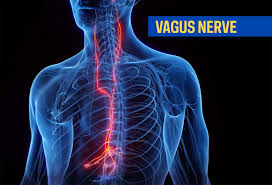
The vagus nerve is the longest cranial nerve, running from the brainstem down through the neck and into the chest and abdomen. It’s the primary highway of the parasympathetic nervous system — the “rest and digest” counterpart to the “fight or flight” sympathetic system.
When the vagus is active, your heart rate slows, your blood pressure eases, your digestion engages, and your nervous system shifts into a calmer state. This is real, well-established biology.
What the vagus actually does
Among other things, vagal activity affects:
- Heart rate and rhythm
- Digestion and gut motility
- Inflammation regulation
- Mood — through connections to brain regions involved in emotional regulation
- Sleep quality
- Voice production (it innervates muscles of the vocal cords)
People with chronically low vagal activity tend to have worse cardiovascular outcomes, more inflammation, and more anxiety and depression. People with high vagal activity tend to recover faster from stress and have better baseline wellbeing.
What works
A few practices reliably increase vagal tone and parasympathetic activity:
Slow breathing
The single most effective and free intervention. Specifically, breathing at around 6 breaths per minute — roughly 5 seconds in, 5 seconds out — synchronizes heart rate and breathing in a way that maximally activates the vagus.
You can verify this with a finger pulse-oximeter or fitness tracker that shows heart rate variability. Heart rate naturally rises slightly on inhale and falls on exhale. Slow breathing exaggerates this in a healthy way.
Cold exposure
Brief cold exposure — face in cold water, end of shower cold, cold plunges — activates the vagus through the diving reflex. The effect is real but doesn’t require expensive equipment. 30 seconds of cold water at the end of a regular shower captures most of the benefit.
Singing, humming, gargling
Activate the vagus indirectly through laryngeal muscles. The strongest evidence is for slow, sustained vocalization — humming or chanting at a steady pace. This is part of why singing reliably improves mood across cultures.
Regular aerobic exercise
Improves heart rate variability over time, a measure closely tied to vagal tone. The benefit shows up over weeks of consistent practice, not days.
Adequate sleep
Vagal tone is highest during deep sleep. Chronically poor sleep reliably lowers daytime vagal activity.
Time in social connection
The “ventral vagal” complex (a refinement of vagus theory associated with social engagement) responds to face-to-face conversation, eye contact, and warm interaction. The mechanism is debated, but the practical effect — that real human connection is calming — is widely observed.
What the marketing oversells
Several products claim to “stimulate” the vagus nerve. Some have legitimate medical applications (implanted vagus nerve stimulators for treatment-resistant epilepsy and depression are a real and FDA-approved therapy). The consumer wearables and apps in this category vary widely in evidence:
- Most “vagal stimulator” wearables don’t reliably reach the vagus through skin in any meaningful dose
- “Vagal supplements” don’t have a coherent mechanism — the vagus is a nerve, not a deficiency
- Specific app-guided breathing programs work to the extent that they get you to breathe slowly — which you can do without an app
The bottom line
The vagus nerve is a useful framework for understanding why slow breathing, exercise, sleep, and social connection feel calming and produce real physiological changes. The same practices that have always been recommended for stress and wellbeing happen to be the practices that most reliably support vagal function.
You don’t need a device. You need 5 minutes of slow breathing, regular movement, and sleep. The biology happens to back this up.
If you’ve been intrigued by vagal hype, the takeaway isn’t that it’s nonsense — it’s that the useful version costs nothing and has been available all along.